Thursday, June 2, 2016

Gurkha Cup 2016

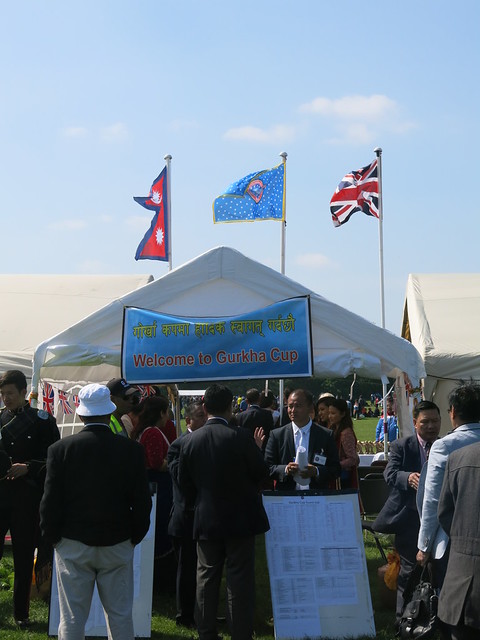
This past week I've been in London and a friend of mine, Premila, invited me to join her at the annual Gurkha Cup day celebrations out in the town of Aldershot, a military town close to Guildford. The Gurkha Cup is an all-day soccer tournament that's been organized by the Tamu Dhee Association and held every year on the Sunday of the May Day bank holiday long weekend.

Gurkha Cup 2016, Aldershot

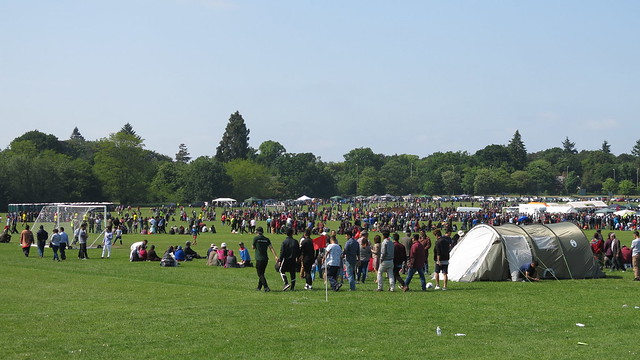
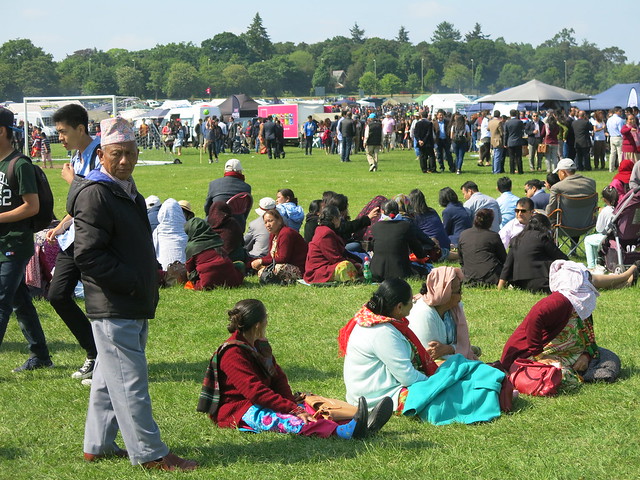
The event draws huge crowds. The vast majority of attendees are Gurkhas (both active and retired) and their families live around Aldershot, as well as in neighbouring towns such as Farnborough. Actress Joana Lumley was instrumental in fighting for the rights of retired Gurkha soldiers to settle in the UK, though this has not been without controversy.

Gurkha Cup 2016, Aldershot

Gurkha Cup 2016, Aldershot

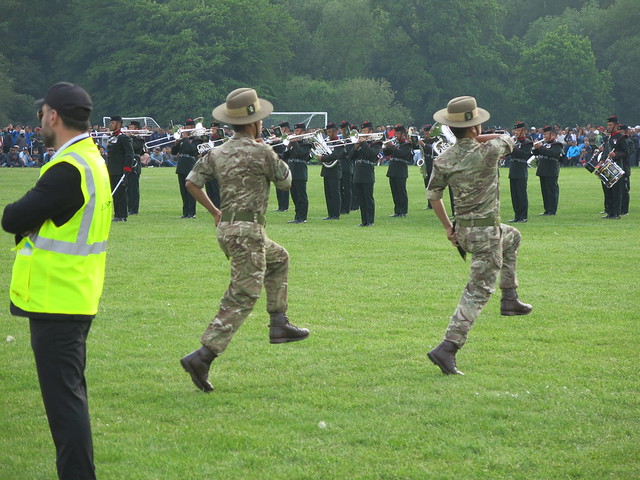
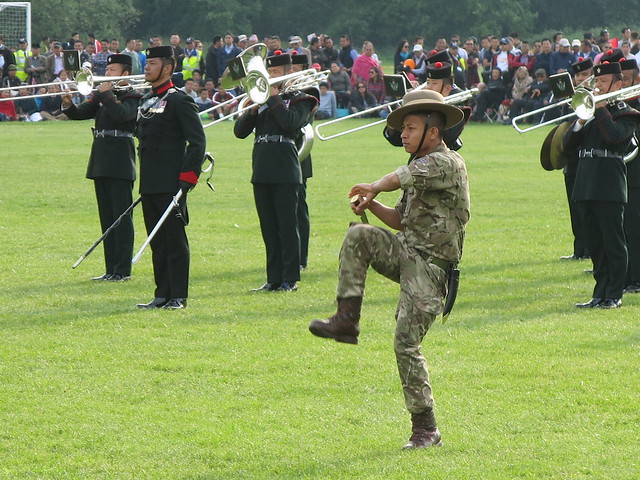
During the half-time show for the final game of the day between QGS Red and B13, we got to see the military band in action, as well as a demonstration of prowess with the traditional khurkuri knife. We didn't actually stay to watch the final, but I did see that Kent FC beat Ilam FC to win the Veterans tournament.

Khukuri knife display, Gurkha Cup 2016, Aldershot

Khukuri knife display, Gurkha Cup 2016, Aldershot


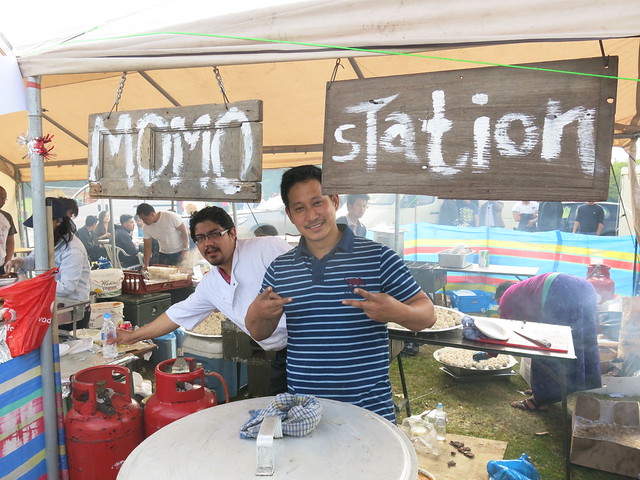
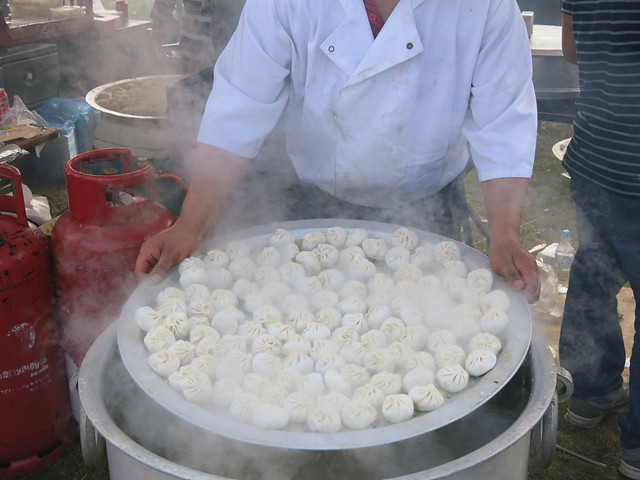
We spent of the time stuffing ourselves with food, especially momos (dumplings) from the Momo Station stall. This looked like the most popular food stall at the fair - the queue never seemed to disappear the whole time we were there! Owner Amit, whom Premila knew, was kind enough to pose for a picture.

Momo Station's owner Amit

Check out the momos here!
Momo Station momos, Gurkha Cup 2016

Premila was also busy pointing out things like the fact that a disproportionate number of Gurkhas and their families come from the indigenous or janajati groups of Nepal, e.g. Gurung, Magar, Rai (FYI, when I'm in Nepal, many people think I'm Rai). For example, in the census data cited in a handbook chapter by David Gellner titled "Warriors, Workers, Traders, and Peasants: The Nepali/Gorkhali Diaspora since the Nineteenth Century", it is estimated that Gurungs make up 22.2% of the Nepali population living in the UK, whereas back in Nepal they only represent 2.4% of the total population. It is also important to note that although Gurkhas speak Nepali, Nepali is not necessarily their first language, nor the main language used at home.

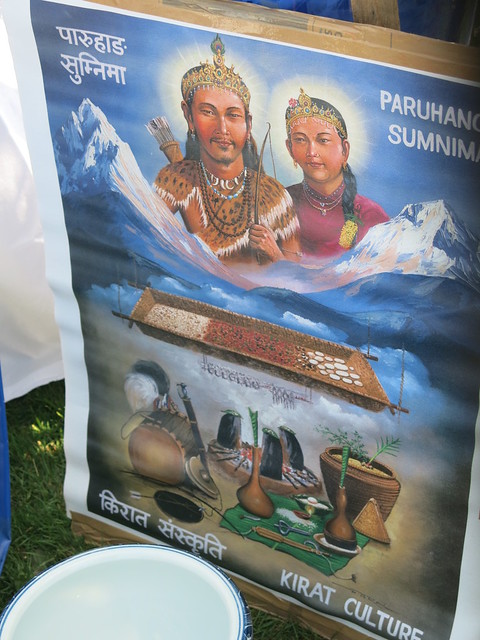
As a reminder of this, a poster we spotted (see below) features the figures Paruhang and Sumnima, who are pretty important to Kirat groups, but not to the dominant groups of the Kathmandu valley. In fact, you're probably more likely to spot this type of poster at an overseas Gurkha event, than in the shops of Kathmandu!


Kiranti poster

It was a great learning experience going to the Gurkha Cup with Premila. She's doing a PhD at the London College of Fashion on Nepali youth fashion in Britain and she's pretty familiar with the Nepalese community in and around London (her mother is also from Nepal). She was also able to highlight some of the fashion trends she'd seen over the years across the board, especially the UK Nepali obsession with Korean fashion (similar to NE India's embracing of all things Korean), Scottish tartans and long cardigans that can be worn over traditional lungis.

To find out more about such trends, check out the awesome PhD proposal video she made!


NEPALI STYLE | PHD PROPOSAL from Premila van Ommen on Vimeo.


One thing we did note was the lack of posters around Aldershot advertising the event. On our way back to the train station, a man curiously asked us what was happening in town. Maybe it would help if the organisers put up more posters, especially close to the railway station, so that more local residents knew what was going on.

And on a final note, I'm heading back to the States in a few days, but if you're around London at the end of August and interested in Nepal, the next big Nepali event will be the Nepali Mela 2016 at Kempton Park!

Thursday, May 19, 2016

Singlish: Creole, creoloid, creolized language?

Today's post is brought to you by "ongoing problems with terminology in linguistics".

As my newsfeed this week has filled up with reblogged and retweeted articles about Singlish, often the first thing that gets mentioned is that Singlish is an English-based "creole". But what exactly does the term creole mean?

In many introductory linguistics textbooks, dictionaries and the Wikipedia entry (at the time of writing), the term creole (or creole language) is mostly commonly defined as a stable natural language that has developed from a pidgin, while pidgin is typically defined as a simplified contact language developed to enable speakers of different languages to communicate.

In other words, a pidgin is said to become a creole when children learn it as their first language and the new language develops its own set of rules and conventions - its own grammar. That means that languages which have "Pidgin" in their names, such as Hawaiian Pidgin, are by this definition actually creoles.


Pidgin on the street?

The issue with this particular definition of creole, when applied to Singlish, is that there is no attested "pidgin" state for Singlish. I've seen a few sources (including the Wikipedia article) that claim that Singlish arose from a pidgin-like English as non-English speakers started to "pick up" the English that was filtering out "into the streets" from English-medium schools established by the British.

This story is problematic because, as most Singaporeans of my parents' generation will recall, prior to the implementation of post-independence language policies, the main lingua franca used between speakers of different languages was not English, but a simplified form of Malay known as Bazaar Malay. In a 1975 article (behind a paywall), John Platt, who was an Associate Professor at Monash University, noted that even at the time of the paper's writing, people with little education would speak a pidgin English only when communicating with tourists, and that outside of areas frequented by tourists, many older people spoke no English at all. Rather, he suggested that:
[Singapore Colloquiul English's] existence can be traced to the transference of certain features from the languages of local ethnic groups to the English acquired by school children in primary and secondary schools. These transferred features were then reinforced by the use of this variety (particularly its basilect, SCE) in informal situations at school and at home among siblings. 
Consequently, Platt used the term creoloid1 to describe a language variety that has not developed from a pidgin, but nevertheless shares a number of grammatical features with known creoles, such as fewer verbal inflections (or more generally, a loss of morphology). Specifically, he was applying this term to the basilectal form, or the most colloquial / informal register of Singapore English. For instance, in this form of Singlish, you don't need to have 3rd person agreement with most verbs: he say 'he says'.


Simplifying or making things more complicated?

Although the term creoloid hasn't gained a lot of currency in creole studies, it is worth noting that this may be because the term creole itself has expanded in meaning beyond "a language that comes from a pidgin". There is much more recognition that all languages are mixed to some extent, and that what we have been previously identified as creoles, may have been the result of speakers of a language shifting rapidly to another one. For instance, in their 1980 book Language Contact, Creolization and Genetic Linguistics, Thomason and Kaufman, distinguish creolized pidgins (creoles that have developed from pidgins), from languages that have undergone changes to their grammar and vocabulary as a result of different degrees of intensity in language contact. They use the term abrupt creolization to describe the outcome of one extreme of the continuum, where there has been intense contact that results in very rapid language shift.

(This leads to the potentially confusing situation where one might use the term creolization to either refer to: the process of a language gaining structure and complexity as it transitions from a pidgin to a creole; or the process of a language losing structure and complexity, when compared to the target language, as adult speakers rapidly shift to the language.)


In any case, we note the inclusion of Singlish in the online Atlas and Survey of Pidgin and Creole language structures (APiCS). However, the editors explicitly state in that in the absence of clear criteria to define pidgins and creoles, their approach was to try and include as many languages as they could which represented the kinds of contact languages that linguists were interested in.

So yes, Singlish is a creole, creoloid and creolized language. But that depends on how you define the terms creole and creolized. It is no longer fair to assume that a creole only refers to a language that came from a pidgin. And maybe that's something that needs to be addressed in textbooks and other sources of linguistic information.

Also, this is the tip of the terminological iceberg - there are other terms around like post-creoles and mixed languages that I don't have the time, energy or qualifications to talk about!


1Although the Platt article appears to be the first published use of the term creoloid, Loreto Todd presented a paper titled "Pidgins and creoles: The case for the creoloid" at the International Conference on Pidgins and Creole in Honolulu that same year.

References
Michaelis, Susanne Maria & Maurer, Philippe & Haspelmath, Martin & Huber, Magnus (eds.) 2013. Atlas of Pidgin and Creole Language Structures Online. Leipzig: Max Planck Institute for Evolutionary Anthropology. (Available online at http://apics-online.info.)

Platt, John T. 1975. The Singapore English speech continuum and its basilect 'Singlish' as a 'creoloid'. Anthropological Linguistics 17(7): 363-374.

Thursday, May 12, 2016

More Singapore English words in Oxford English Dictionary

The BBC just covered this story: Singapore terms join Oxford English Dictionary, which is basically about how Singapore English words like wah and shiok get to join their linguistic compatriots lah and kiasu in the OED, the world's "definitive record of the English language".

There's even a little quiz at the bottom of article for those of you who want to flaunt your Singlish.

However, I was drawn to the opening line of the article, which I think continues to perpetuate the myth of how words end up in the OED (and many dictionaries in general):
Several Singaporean and Hong Kong English terms, including "wah", "shiok" and "yum cha", are now officially recognised as acceptable English.
By saying that these new words are "now officially recognised as acceptable English", the BBC article continues to perpetuate the myth that the job of the OED is to be the judge of what is acceptable or not acceptable English, and that it serves as the standard which English (or at least British English) speakers can fall back on to check if a word exists, and to see if they or other people are using it in the "correct" way. And while there are many languages that have organizations that regulate their use, English is not one of them.

A quick look at the OED FAQ site, where they answer the question "How does a word qualify for inclusion in the OED?" provides us with the following statement:
The OED requires several independent examples of the word being used, and also evidence that the word has been in use for a reasonable amount of time. The exact time-span and number of examples may vary: for instance, one word may be included on the evidence of only a few examples, spread out over a long period of time, while another may gather momentum very quickly, resulting in a wide range of evidence in a shorter space of time. We also look for the word to reach a level of general currency where it is unselfconsciously used with the expectation of being understood: that is, we look for examples of uses of a word that are not immediately followed by an explanation of its meaning for the benefit of the reader. We have a large range of words under constant review, and as items are assessed for inclusion in the dictionary, words which have not yet accumulated enough evidence are kept on file, so that we can refer back to them if further evidence comes to light. (bold emphasis added)
Vague as the statement is, the criteria for entry are more or less about the frequency of use of a word and its intelligibility. Nowhere do we see the term "acceptable" - although the notion of "general currency" implies that there has to be some kind of social agreement to use a word in a particular way.  The BBC's use of the word "acceptable", in conjunction with "officially recognised", also makes it very difficult to ignore the connotations of social prestige, formality and flaunting one's class and education - all of which have little to do with how a word gets into the OED.

Rather, the OED is a descriptive dictionary that serves as a repository of the words (past and present) that are or used to be in circulation within the different pockets of the English speaking world, much like the Coxford Singlish dictionary (pictured below) is a repository for all kinds of Singlish terms used at the time of publication (and earlier) in Singapore. Of course, the OED is also historical in that it maintains a list of obsolete words, as well as obsolete meanings of words.


The Coxford Singlish Dictionary (edited by Colin Goh and Y. Y. Woo) 

Of course, just as people may assume prisoners are guilty simply because they are in prison, once a word enters the OED, it may eventually gain the kind of acceptability or prestige that people assumed it needed to get in there in the first place.


(Addendum: as much as this post was about the descriptive nature of the OED, and how it isn't intended to be used as a prescriptive tool, I cannot ignore the power that is often ascribed to dictionaries. For speakers of non-prestigious minority languages and language varieties, the very existence of a dictionary in their language or variety is a mark of status: the dictionary not only validates the words they speak, it validates their entire language as something worthy of speaking and studying.)

Thursday, September 18, 2014

A phonological and phonetic description of Sumi, a Tibeto-Burman language of Nagaland

So I should probably apologise / apologize for my lack of updates the past year or so. It's been pretty crazy since I started grad school - I'd have to spend many a blog post explaining all the wonderful things I've been able to do since I started in the linguistics PhD programme here at the University of Oregon.

In the meantime, in the 'American' spirit of self-promotion, I thought I should mention that I finally finished revising my University of Melbourne MA thesis A phonological and phonetic description of Sumi, a Tibeto-Burman language of Nagaland and got it published with Asia-Pacific Linguistics in Canberra.
It's an open access ebook (print on demand), and you can download it right here at the ANU digital collections page here.

I have too many people to thank for this, especially my family who've supported me all through this crazy journey, as well as the Sumi community / my Sumi family. I'm so thankful for all the amazing people I've met along the way, and all the help I've received in making this possible. Noshikimithi va na!

Monday, December 2, 2013

The examples linguists use

My apologies to all my readers, I just haven't had all that much time to blog since I started grad school, though I have a lot of things I'd like to blog about! (I'll be making time after finals week next week to catch up on my posting.)

Thanks to the Nom Nom Linguistics Facebook page, I just found out about this Tumblr site called
Linguistics Sample Sentences: http://lingsamplesentences.tumblr.com/

Here you can see a selection of the weirdest / funniest / slightly more obscene examples that linguists use to illustrate various points about the grammars of other languages. Sometimes linguists need these 'weird' examples to see how a language performs a certain function. Sometimes these examples highlight how creative the speakers of a language can be.

And sometimes linguists just choose the weirdest examples for comic relief. (Because talking about grammar.)

In general, I'm told we sound like a violent bunch. If we're trying to study something like transitivity -simply put, the ways in which languages describe an event that involves more than 1 participant- the most common examples you see tend to involve a verb like hit, e.g. John hit Mary or Mary hit John. However, I've even been told that hit is not always the best example of a transitive verb (for the linguists: this is because in some languages, the verb hit may take an argument with locative marking instead of patient marking), so what you really need is a verb like kill to illustrate the point!

Great, even more violence.

I think the weirdest sentence I've had to elicit from a language consultant was "The man cooked me for the chicken." But I'm sure there'll be weirder ones to come!

[Note: the point of such examples is not and should not be to make fun of a language or speakers of a language - if anything, we're both showing appreciation and poking fun at the nature of the science  for (a) making linguists ask speakers of a language to say a particularly unnatural utterance; and/or the linguist themself for (b) choosing that particular example to put in a publication just to illustrate a certain point, when another (though less humorous) example would have sufficed. But it's what you have to do if you're trying to work out the genius and creativity underlying any spoken language.]

Saturday, October 26, 2013

On Not Having a Mother Tongue

At the moment, I'm TA-ing for a course called Language and Power here at the University of Oregon, and I've been recounting the following story to my students.

It happened more than 10 years ago after I'd just moved from Singapore to Melbourne. I was at my university orientation, where I met a number of people, including a guy from Sweden. We got to talking, and he eventually asked me what languages I spoke. I told him that I spoke English and some Chinese (Mandarin), but that my Chinese wasn't very good.

The very next thing he said to me was, "Oh, so you don't speak any language well!"

Before I could recover from the shock of what he'd just said, he quickly proceeded to 'correct' my English. I remember we were talking about purchasing textbooks for our courses at a particular bookshop. I said something like: "You can get them cheap over there." He told me that it should be: "You can get them cheaply over there." because you need an adverb with the verb 'get'. At that point, I said something like, "No, I'm using it as an adjective to describe the thing I'm getting." But it was clear that I had little say in what was 'right' or what was 'wrong'.

Now this was before I'd started any formal study in linguistics, but I had had 'English grammar' lessons in school in Singapore, with explanations given for many 'grammatical rules'. Of course, people like me were a pain for our English teachers because they'd give us a particular phrase or sentence, and ask us why it was 'correct' or 'grammatical'.

We'd just say, "Because it sounds right."

And that's the thing about your 'mother tongue' - you don't need to be formally taught the rules of the language in school. Through enough exposure as a child, you just know what 'sounds' right and what doesn't. That knowledge is what linguists usually think of as 'grammar' - it's not the rules that you are explicitly taught in a classroom (unless the language is not your native language), it's knowing how to say things that don't sound odd to either you or the people from the community you grew up with.

To be repeatedly confronted and told that my mother tongue - the language I used at home and in daily life, and the language I knew best (let's not even go into what Singapore calls one's 'mother tongue') was 'incorrect' or defective has had a few effects on me. On the downside, I find it difficult to claim 'ownership' or 'expertise' in English. Even now I am quick to get defensive about my own linguistic knowledge, sometimes justifiably so, but sometimes I perhaps get a little too defensive. On the upside, I've often felt motivated me to learn more languages (to varying degrees of fluency). Most importantly, this insecurity has made me delve deeper into the field of linguistics.

Jacques Derrida, in his book Monolingualism of the Other, wrote, "I have but one language - yet that language is not mine." While his words can be interpreted on many different levels (his central thesis was that we are all alienated from our 'mother tongue'), I can think of no better quote to apply to the linguistic situation I find myself in. I also imagine that this is something many people in the modern world whose 'languages' or 'dialects' are looked down upon and vilified can relate to.

(Yes, I ended that last sentence with a preposition. And yes, it's perfectly grammatical to do so in English.)

Monday, September 30, 2013

Fun with tone sandhi - The solution!

Okay, I apologise for the long delay, but finally(!), I present you with the solution to the problem set I posted in my last blog post, many months ago (see here).

(Right click the image below and select 'Open Image in New Tab'.
Or click here for an image you can magnify.
The language is Singaporean Teochew, as spoken by an aunt of mine who lives in Singapore. It's part of the Min Nan group of languages, but Singaporean Teochew is said to have undergone dialect leveling with Singaporean Hokkien - the two are much more mutually intelligible than their counterparts still spoken in China today. Also, although most descriptions of Teochew give 8 tones, I've only been able to find 7 contrastive ones - but there might still be an 8th one that I've missed!

I know I was supposed to post this in mid-June, but a lot of stuff came up, including a move to the United States (via Australia). As some of you may already know, I've just started grad school at the University of Oregon, where I am pursuing a PhD in Linguistics. It's a really exciting time for me. I'll be heading back to India at some point during my course, but unfortunately not this year.

Looking forward to posting about all the cool linguistics topics I'll be looking at during the next year!

Saturday, May 25, 2013

Fun with tone sandhi

The past few months, I've been learning a language here in Singapore that's been noted for its crazy mind-bending use of tone sandhi. I thought I'd write a little about it in this post, since it's a phenomenon that some linguists may not be familiar with (given the tendency for many to run away at the first 'hearing' of anything tonal). At the end of this post, I'm also going to throw in a little puzzle set that I created, just to give people a chance to see the sorts of data some linguists work with. I'm hoping it'll appeal to all the puzzle solvers out there.


Tone sandhi in Mandarin Chinese
Experienced learners of Mandarin will already be familiar with the phenomenon, exemplified by the initially confusing and dreaded rule that specifies that Tone 3 becomes Tone 2 before another Tone 3. This prevents you from saying two Tone 3s, one after the other. For example, the word for 'you' in Mandarin is 你 nǐ (with Tone 3) when said on its own and the word for '(to be) good' is 好 hǎo (also Tone 3). However, when you put them together to get the ubiquitous Mandarin greeting 你好, written as  hǎo in Pinyin, you find that 你 is now pronounced with Tone 2. (This makes it homophonous with 泥 'mud', but most speakers can work out from context that you're not talking about the quality of earth.)

Importantly, the rule applies whenever two Tone 3s occur next to each other in the same phrase, regardless of the actual meaning of the words. Using another example, 很 hěn, an intensifier with the meaning of 'very', remains as Tone 3 in phrases like 很多 hěn duō 'a lot' and 很快 hěn kuài 'very fast', since 多 duō has Tone 1 and 快 kuài 'has Tone 4. But if you want to say 很好 hěn hǎo 'very good', you would have to pronounce 很 as hén, with Tone 2.

Ask a native speaker of Mandarin why on God's less-than-green earth they would say 你好 or 很好 this way, and they'll probably just say that 'it sounds nicer'. There's also actually no physiological, or aesthetic, reason preventing you from producing two Tone 3s in a row. The thing is, tone sandhi rules are language-specific: some tone languages do allow sequences of similarly low (and creaky) tones to occur next to each other, while others may disallow sequences of two falling tones, which Mandarin does allow.

Of course, if you're only interested in learning a tone language that does have tone sandhi, it doesn't really help to ask why it happens, or for instance, why Tone 3 becomes Tone 2 and not Tone 4. You just need to accept that it does happen and that it happens the way it does. And then you need to learn how to apply the tone sandhi rules in actual speech so you don't sound completely moronic.


Tone sandhi vs Tone change
On the other hand, if you're in the business of describing tonal languages, tone sandhi is something that pops up again and again. It can sometimes be a little tricky to talk about, since there's still some disagreement as to how to what the term 'tone sandhi', sometimes called 变调 biàndiào in Mandarin, should include. At least, it is generally accepted that 'tone sandhi' differs from 'tone change', or 变音 biànyīn, which describes similar kinds of tone alternations that are restricted to specific words, largely due to historical reasons. For example, 好 when pronounced hào with Tone 4, means 'to be fond of' (example taken from Chen 2000: 31) - here you can see the connection with 好 hǎo '(to be) good', which indicates a likeable quality. However, this correspondence between Tone 3 and Tone 4 is specific to 好, and changing Tone 3 on another word to Tone 4 is not likely to yield a similar change in meaning.

In contrast, tone sandhi rules, which can also be the products of historical changes in a language, are more 'general', in the sense that they almost always apply regardless of the meaning of words as long as the necessary sound environment condition is present. However, there are instances when tone sandhi rules are not strictly observed - even native Mandarin speakers may sometimes fail to observe the rule described above when confronted with new compound words consisting of Tone 3 + Tone 3.


A tone sandhi puzzle
In the process of learning this tonal language in Singapore, which I'm calling 'Language X' for the moment, I came up with a little puzzle involving tone sandhi. It's similar to the problem sets we give out to undergraduate linguistic students, except I've simplified it a little so you don't need a lot of linguistic knowledge to solve it. I've used the letters A-G to indicate the tones, as well as some symbols known as Chao tone letters which give a visual representation of the tones. The 'stopped' tones refer to tones on words that end in the consonants k and h.

You can view a draft of the puzzle below. Now this may not be the easiest puzzle to cut your linguistics teeth on, but I hope it gives you a taste of the sorts of data linguists work with, and the kind of analytic skills required to describe languages.

(Right click the image below and select 'Open Image in New Tab'.
Or click here for an image you can magnify.) 


The solution will come in mid-June!

[I may have to post less frequently than I already do this coming month because I'm busy revising my Masters thesis to get it published.]


Reference
Chen, Matthew Y. 2000. Tone sandhi: Patterns across Chinese dialects. Cambridge: Cambridge University Press.

Tuesday, May 14, 2013

Issues with Ice Age linguistics

Last week I had a few friends ask me about a recently published study titled "Ultraconserved words point to deep language ancestry across Eurasia" by Mark Pagel, Quentin D. Atkinson, Andreea S. Calude and Andrew Meade. It's been making headlines all over the globe in articles with titles like "English May Have Retained Words From an Ice Age Language" (Wired.com), "Ice Age language may share words with modern tongues" (News.com.au and various sites) and "15000-year-old 'fossil' words reveal ancestral Ice Age language" (LA Times).

You can download their report here. Also, the data for the study comes from the Languages of the World Etymological Database, which can be accessed at this site.

As always, Language Log has a great post by Sally Thomason that highlights many of the issues about the study here, including issues with both the data and methodology. Similarly, another post at GeoCurrents by Asya Pereltsvaig rubbishes the study.

Now, before you go and cry 'Academics marking territory!', there are very good reasons to take the study by Pagel et al. with a sea-ful of salt. But let me start with a short personal anecdote and brief introduction into the world of historical linguistics. Also, if you're a believer in Nostratic, you should probably just ignore this post altogether.


Nagaland and the Yucatec Peninsula?

A few years ago, a friend of mine from Nagaland in North-East India saw Mel Gibson's Apocalypto and was astounded that her language and Mayan (technically, Yucatec Maya) shared a number of words in common. She thought the two languages might be related and asked me about it. I told her this was highly unlikely given (a) the geographic distance between the two and (b) the lack of any recent contact between the people of Nagaland and the Mayans. Of course, I could tell she was still sceptical of my response even some time after.

Now my dismissal of her theory wasn't just because I found the geographic distance and lack of recent contact problematic (or the fact that she was basing her observations on translations given in the subtitles). It was the fact that given the geographic distance and the lack of recent contact, the words she cited were just too similar in both pronunciation and meaning. Such similarity between cognates, that is, words in related languages that are descended from the same etymological source (and not through borrowing), is actually highly unlikely. Such words rarely keep both their original form and meaning as time goes by, and the languages they belong to drift apart. As an example, let's look at the Italian word for 'dog': cane (pronounced /ka.ne/, like 'car-nay' with a [k] sound at the start). The French equivalent is chien (pronounced /ʃjɛ̃/ with a sound usually written in English as sh). Despite both words deriving from Latin canis, the modern equivalents in Italian and French sound quite different.


Historical Linguistics 101


(Image by Koryakov Yuri, taken from Wikimedia Commons)

To address this problem of sound change, most historical linguists apply what is known as the Comparative Method. The idea is to look for sound correspondences across a number of words in two languages, and not just individual words in each language that sound identical and mean the same thing. Applying this method reveals that the /ʃ/ 'sh' sound in French (written as ch) regularly corresponds to a 'k' sound in Italian (written as c): compare French chanter with Italian cantare 'to sing', French bouche with Italian bocca 'mouth'. It is these regular sound correspondences that form the basis for genetic groupings of languages, not similarities in the actual forms of the words themselves. Historical linguists will then use these sound correspondences to attempt to reconstruct a 'proto-language' from the forms in the modern languages. Such proto-languages are always theoretical - even 'proto-Romance', a proto-language reconstructed based on modern Romance languages like Spanish, Sardinian and Romanian, is not identical to Vulgar Latin, which had many varieties spoken in across the Roman Empire.

However, even before historical linguists can begin to establish sound correspondences, they first need to identify cognates in various languages. This process of identification is complicated by the fact that words don't just change in pronunciation, they also change in meaning. For example, English dog and Swedish hund /hɵnd/ 'dog' sound nothing alike, even though they share the same meaning. On the other hand, English hound /haʊnd/ and Swedish hund share many similarities in pronunciation, with similar consonants both at the start and end of each word. However, Swedish hund refers to any kind of dog, while English hound refers to only a specific breed of dog. Which word in English would we say is cognate with Swedish hund then? Given the similarity in pronunciation and the somewhat related meaning, hound is the more likely answer.

Now this may not look like a huge semantic leap that could cause much confusion, but a combination of both sound drift and semantic drift can make it difficult to locate cognates. Take for instance, the Swedish word for 'animal', pronounced /jʉːr/, almost like English you're. Based on this spoken form, can you think of a word in English that might be cognate with this?

Unless you know something about proto-Germanic linguistics, I'm guessing that you probably weren't able to work out that the Swedish word for 'animal'written as djur, is actually cognate with English deer. (Yes, the spelling might have helped, but imagine you're working with languages that have no written records.) The word deer in English does not refer to animals in general, but to a specific kind of animal, somewhat analogous to English hound. Speakers of German may have seen the connection, since German Tier means 'animal (in general)' and still sounds similar to English deer. However, the point here is that as languages diverge more over time, the task of identifying cognates between them gets increasingly difficult.

Certain types of sound and semantic change are quite common, and follow well-established patterns. For example, in a number of languages, the word for 'five' is historically derived from the word for 'hand': compare Malay lima 'five' with Hawaiian lima 'hand' (see here for more words for 'hand' in Austronesian languages). However, the rules governing such changes are not necessarily predictive, and at best can only give a probability that a word developed from a particular source. This is when historical linguists can get rather creative in deciding whether two words are cognates or not - disagreements over what words should be used as cognates can lead to rather different reconstructions of what is supposed to be the same hypothetical proto-language.


Swooning over Swadesh lists

To help identify cognates, many linguists start by comparing items from Swadesh lists in various languages. The list was first developed by Morris Swadesh in the 1940s and 50s and contains words that are viewed as belonging to the 'core vocabulary' of all languages, as opposed to culturally-specific vocabulary. Depending on the version of the list, there may be 100 or sometimes up to more than 200 items on the list. The items include nouns referring to body parts like 'heart' and 'tooth', personal pronouns like 'I' and 'we', kinship terms like 'father' and 'mother', some verbs of motion, the numerals 1-5, etc. It was originally assumed that such 'core vocabulary' was more stable over time and underwent replacement by other words in the language at a slow but constant rate, analogous to the process of radioactive decay. Furthermore, there was the implicit belief that words for such 'basic' concepts were not likely to be borrowed from other languages.

Based on such assumptions, Swadesh applied a method called glottochronology to these word lists, which then allowed him to propose dates for when various languages / language families split from each other. Today, this method has been largely discredited, mainly for its flawed assumption that word replacement happens at a steady rate across languages and across all words in a language - although there do remain proponents of this type of research. Furthermore, 'core vocabulary' is not always resistant to replacement by borrowed words. One notable example of this is the adoption of the Chinese numeral system in the genetically unrelated Japanese, Thai and Vietnamese languages.

Despite all these limitations, many field linguists and historical linguists see the Swadesh list as a useful starting point, myself included. But any decent fieldworker or historical linguist would also know that you need to move beyond a Swadesh list consisting of some 200 items (at the maximum) if you want to get any real insight into a language and its past. One needs to go beyond studying the etymology of only 'core vocabulary' and look at other areas like morphology (e.g. prefixes and suffixes), syntax, as well as sociolinguistic variation. Some linguists would also argue for the need to look at vocabulary associated with agriculture and material culture, words that the Swadesh list deliberately omits. In a sense, Swadesh lists are the 'standardised testing' of historical linguistics, designed to make quick and 'consistent' comparisons by omitting large amounts of information and disregarding any subtle nuances in the data. A study that uses data drawn solely from Swadesh lists is inevitably going to be woefully inadequate, just like education policies based entirely on the results of standardised testing.


Words frozen in time?

Coming back to Pagel et al's work, which I now have the overwhelming desire to call the 'Ice Age language study', I hope you can start to see some of the problems with their methodology. Now I'm certainly not saying that their methodology is as basic as my friend's casual linguistic comparison of what are essentially false cognates (pairs of words with similar pronunciation and meaning but very different sources) in her language and Yucatec Maya.

Nevertheless there are issues with their study, as listed here:

(1) They only use Swadesh list data.
(2) There are a number of inaccuracies in the data used to reconstruct certain proto-words, as noted by Thomason.
(3) They apply the Comparative Method to reconstructed proto-words, which are themselves hypothetical and disputable, to reconstruct even older proto-words. (Note: this is acceptable, but only if your first reconstructions are solid.)
(4) There are some questionable judgements about which words to treat as cognates, although this is always going to be a subject of debate in any historical linguistic research. Some linguists simply err on the side of caution, while others are more liberal in their judgements.

It should be obvious by now that this is not an exact science - you can apply all the statistics you want, but if the initial data is based on somewhat subjective judgements, the results of the statistical analysis are not going to be very convincing. To their credit though, they try to show that the rate of word replacement can be correlated with frequency of use, and provide a more empirically-based study than what Swadesh did, even if this study is based on just 200 items on the Swadesh list.

Personally, I find questions about the origins of language families fascinating because they are intimately linked to human migration in prehistoric times, and going back deep enough, to our origins as a species. Judging by the amount of media coverage, this also seems to be an issue that media outlets believe people are interested in reading about. All that I've said doesn't mean that I don't believe that a super 'Eurasiatic' / 'Ice Age' language could have ever existed - I'm certainly in no position to say if one did or did not. I just don't think the evidence provided is compelling enough to suggest that one did. And given the time depth we are talking about, it's doubtful that we'll be able to recognise true cognates using the Comparative Method.

I don't think linguistics by itself will be able to give any satisfying conclusions about our origins, or about prehistoric human migration. But this doesn't mean that we should abandon the collection of linguistic data altogether. Comparative work like this calls for a lot more subtle attention to detail than lists of 200 words. Linguists, such as Roger Blench and George van Driem have also increasingly started to collaborate with anthropologists, archaeologists and geneticists to try and corroborate findings for each field in order to provide a better picture of our prehistoric movements.  More sophisticated statistical, genetic and geography-based computer modelling are also being developed and some are being applied to linguistic data. With any luck, some of these will bring promising results in the future.

Saturday, May 4, 2013

What a 'hotel' can mean in India

According to the Online Etymology Dictionary, the English word hotel was first recorded in the 1640s and denoted a 'public official residence'. The modern sense of the word as 'an inn of the better sort' (i.e. 'a place offering lodging, food and other services to travellers') was first recorded in 1765. The word comes from the French hôtel, which itself is derived from the Medieval Latin hospitale via Old French hostel.

In French, hôtel was used to refer mainly to public official buildings that frequently received visitors, but this has been largely replaced by the meaning of 'place offering lodging and food to travellers', as used in contemporary English. However, you can still see traces of this old usage in words like hôtel de ville 'town hall' and hôtel des impôts 'tax office' and hôtel de police 'police headquarters'.

In India, the term hotel has taken on a slightly different meaning (and pronunciation, with stress on the first syllable, not the second.) Visitors to India are likely to find that big modern buildings offering lodging are called 'hotels', but they might be slightly shocked to see signs for hotels that do not provide lodging at all.

Take for instance this hotel located right next to the Dimapur Railway Station. As you can see, the hotel only offers 'fooding', a very common term in Indian English meaning 'the provision of food' - this can include the catering at an event or simply selling food at a restaurant.

Next to Dimapur Railway Station

I'm not entirely certain how the term 'hotel' has come to be used to refer to (what I would call) a 'restaurant', where only food and no lodging is provided. I doubt that this use derives from the original French meaning of a public building that frequently receives visitors. Incidentally, there are also hotels in India that advertise 'only lodging' with no 'fooding'.

My guess is that the term did originally designate a place frequented by travellers and provided both food and lodging - I imagine that travellers were the most likely people to frequent places offering food since most people would have taken their meals at home or packed their own food. Over time, some establishments may have stopped providing one service or the other for whatever reason (e.g. greater profits from selling food), but the label 'hotel' remained. Consequently, the term 'hotel' no longer denoted a place of lodging, but simply a place frequented by travellers. Someone else starting a restaurant near a train station or along a highway may then choose to call their business a 'hotel', even though they have no intention of providing lodging, as long as their expected clientele are likely to be travellers stopping in for a meal.

Whatever the history of the word may be, don't be shocked if you rock up to a hotel in India and can't get a room - some of them simply don't have any for guests!

Wednesday, May 1, 2013

Taiwan indigenous languages on television

One of the things I was impressed with during my short stay in Taiwan was the Taiwan Indigenous Television (TITV) channel, which features programming for and by indigenous peoples of Taiwan, including news programmes, educational shows and variety shows.

Here's a screenshot of a programme that is in (what I assume to be) the Seediq language (sometimes still classified with Atayal).


And here's a screenshot of a news programme in what I assumed was the Amis language ('Pangcah' is the endonym for the group). Although I couldn't understand what they were saying, I did see that the story they were running was about Julia Gillard's March 21 apology to victims of forced adoptions in Australia. Her apology echoed Kevin Rudd's 2008 apology to victims of the Stolen Generation, a policy which I believe has some resonance among the indigenous people of Taiwan, given their own experience of institutionalised racism.


Speaking of the Amis language, most people around the world would have actually heard bits of an Amis song without even realising it. Remember Enigma's 'Return to Innocence', which was used in ads promoting the 1996 Summer Olympics in Atlanta?


The 'chant' you hear right at the start, then throughout the song was actually sampled from a recording of a tradition Amis song titled 'Elders' Drinking Song' (or 'Jubilant Drinking Song' or 'Weeding and Paddyfield Song No. 1'), as performed by Difang Duana and Igay Duana (also known as Kuo Ying-nan and Kuo Hsiu-chu) while they were in Paris on a cultural tour in 1988.

The Maison des Cultures du Monde in France recorded the husband and wife duo, along with 30 other visiting artistes, and created a compilation titled 'Polyphonies vocales des aborigènes de Taïwan'. However, they failed to properly credit the Duanas and their compatriots. Michael Cretu, the producer of Enigma, was later sued for not giving proper credit to the original singers, stating that he had assumed the recordings belonged to the public domain and thus were not subject to intellectual property rights. The case was eventually settled out of court. [Click here for more details.]


Sadly, Difang and Igay Duana both passed away in 2002, but I found a video of them on Youtube taken in 2001 singing a bit of the song in their garage. You can still purchase their 1998 album Circle of Life on iTunes which features the famous song and was produced by Rock Records.


This issue of 'indigenous intellectual property rights' is a very tricky but important one for people involved in the documentation of language, indigenous art forms and scientific knowledge. For one thing, the 'owner' of such intellectual property is rarely a single individual or two but rather an entire 'community' - itself a problematic notion that does not always correspond to a stable cohesive unity. [Click here for Gawne and Kelly's presentation at this year's International Conference on Language Documentation and Conservation.] At the same time however, there is seen to be a need to safeguard such intellectual property (be they songs or botanical knowledge) from what could be called 'exploitation' by outsiders who offer no compensation to any members of that community (even if it is difficult to determine what one considers exactly to be 'exploitation').

Perhaps having a television channel that advocates for indigenous rights and which produces and airs programmes related to traditional culture is one way of documenting and showcasing traditional art forms to a wide audience without the threat of 'exploitation' - in fact, many of the educational programmes on TITV are aimed specifically at imparting traditional knowledge to children belonging to the relevant indigenous community.

Of course this is not a solution for all indigenous peoples, even within Taiwan, especially for smaller groups with insufficient resources and viewers. Furthermore, as we see people move away from more 'traditional' forms of media like radio and television to online media, the nature of the debate surrounding indigenous intellectual property rights will undoubtedly continue to change.

Sunday, April 28, 2013

Sun Moon Lake and Assam Tea

Last month, I was in Taiwan for about a week with Mum. We spent a few days at Sun Moon Lake (日月潭), which we used as a base to visit our places, including Alishan (阿里山). The mornings and evenings were blissfully quiet without the hordes of tourists arriving by mid-morning.

Sun Moon Lake (日月潭), Taiwan

Sun Moon Lake (日月潭), Taiwan

Sun Moon Lake (日月潭), Taiwan

One thing I did not expect to see were signs for 'Assamese Black Tea' products, including this one for 'Assamese Black Tea' egg rolls.


This signboard near the Shuishe visitor centre also mentioned 'Assam Black Tea Cuisine'.


What I didn't realise was that in 1925 (or 1926), black tea from Assam was brought by the Japanese to the Sun Moon Lake area for cultivation. Apparently, the climate and soil conditions of the area are similar to those of Assam and so the tea thrived here. I have to admit, the area did remind me a little of North-east India, but mainly because of the extensive betel nut (areca nut) plantations filling the valleys! Today, black tea production still continues, albeit on a smaller scale. There's a Sun Moon Lake Antique Assam Tea Farm in nearby Yuchi (鱼池) if you're interested in learning more about tea cultivation in the area.

Sun Moon Lake (日月潭), Taiwan

Sun Moon Lake (日月潭), Taiwan 

I should also mention that the area around Sun Moon Lake was previously inhabited mainly by the Thao (pronounced [θau]), many of whom continue to live close to the lake. They are the smallest group out of the 14 officially recognised aboriginal tribes of Taiwan. The Thao language, an Austronesian language, is critically endangered - Robert Blust estimated that there were only about 15 remaining fluent speakers living in the village of Barawbaw (now commonly known as Ita Thao (伊達邵), seen in the photos above from across the lake) when he published his dictionary of the Thao language back in 2003. Despite Blust's amazing efforts in making what is perhaps the most comprehensive dictionary of a Formosan language, the language unfortunately looks to be moribund, if not already extinct. Blust also was thankful that the community emerged mostly unscathed from the deadly 1999 earthquake which caused massive damage around the country.

On a final note, the day Mum and I left Sun Moon Lake, a magnitude 6.1 earthquake struck the region. We had just left the lake by bus and had arrived at the Taichung High Speed Railway station. The quake struck while we were waiting for our train to take us back to Taoyuan to catch our flight back to Singapore. The section of the high speed railway we were supposed to travel on was shut down for several hours while inspections took place. However, thanks to some very helpful locals, and Taiwan's amazing intercity transport network, we managed to catch a bus straight from Taichung to the Taoyuan International Airport to catch our flight home.

Spider at Sun Moon Lake (日月潭), Taiwan

Sunday, April 21, 2013

Phou-oibi, the Rice Goddess - a Manipuri ballad opera

I just got to see Phou-oibi, the Rice Goddess, as part of the Tapestry of Sacred Music 2013 programme here at the Esplanade in Singapore.  It is described as a Manipuri ballad opera, performed by the Laihui Ensemble from Manipur in North-East India.

It tells the story of a number of goddesses, including the Goddess of Fish, the Goddess of Water, the Goddess of Land, the Goddess of Metal, the Goddess of Wealth and the eponymous Goddess of Rice, Phou-oibi, who are sent by the Supreme God to the realm of humans, Lamlen Madam Madaima, to help them prosper. However, when they try to leave, they are stopped by the four protectors of the realm, under the orders of the Supreme God who believes that humanity will suffer once they leave. Phou-oibi, the Goddess of Rice, is the only one unable to escape - the stream she tries to cross turns into a huge river. Unable to cross the river, she meets a man, Akongjamba, who is out hunting. They meet and recognise instantly a connection they had in a past life. Akongjamba eventually proposes to Phou-oibi, who makes him wait till the full moon of the month of Sajibu to give her response. [Incidentally, we are currently in the month of Sajibu, which started last week with Sajibu Cheiraoba, the Meitei New Year.] However, at the appointed time, Akongjamba fails to show up. Enraged, Phou-oibi throws paddy down on the land.

According to the creative director, in other versions of the tale, the two end up together. In one version I just found in the book The Lois of Manipur: Andro, Khurkulm, Phayeng and Sekmai, Phou-oibi only spends a day in Akongjamba's house before she is forced to leave by his mother.

You can see short excerpts from the show here:


There are also videos of the performance on Youtube, though I'm not sure whether the uploader has the copyright.


I thought it was a wonderful production, from the performance to the lighting. The women, and especially the lead female, showed such control over their bodies and voices. I particularly enjoyed the flowing hand movements. I was also impressive by the physicality of a somersault that the women performed, given the limited movement afforded by their clothes and accessories (the wrapper around their waist, is what I think is called a phanek).

The post-performance talk / Q&A left a sour note in my mouth though. The very first question was, "Where are you from?", which I found to be incredibly offensive and disrespectful to the performers, given that the information was provided in the programme! As a follow-on question, I heard the same audience member make a comment that they didn't 'look Indian'. Surely, there are more culturally appropriate ways to ask someone about their place of origin. For instance, "I'm not familiar at all with Manipur, could you please tell me more it?" In contrast, asking "Where are you from?" basically implies, "The programme says you're from India, but where are you really from?" And of course, I get upset about these things because I have many friends from NE India who have to continually assert their membership as 'Indian citizens', both outside India and even when they live in other parts of India - though I do think / hope this is changing, with greater visibility by people like Mary Kom, a boxer from Manipur who won Bronze at last year's Summer Olympics.

But that aside, going back to what I loved about the show - what I loved most was, as stated in the programme, that the production was a collaboration between the various performers, musicians and artists and more importantly, that:

"Laihui Ensemble's The Rice Goddess gives free rein to its artists to improvise, and in doing so, allows them to reconstruct a traditional art form into a contemporary setting."

Culture and cultural performances are not static (unless we want them to be), and I think there's a lot to be said for finding the right balance between respecting tradition and producing work that a contemporary audience can still appreciate, even if it is a niche audience looking for something 'exotic'.

Friday, April 12, 2013

Happy New Year(s) on the Indian subcontinent

India and its immediate neighbours celebrate not one, not two but... a bewildering number of New Year's Days (not even counting the one in the Gregorian calendar, the Islamic New Year and Tibetan New Year). In fact, this week alone will see the start of a new year for a number of different communities across South Asia - and they don't all fall on the same day or signal the start of the same year!

If you are Kannadiga or Telugu living in Karnataka or Andhra Pradesh, you would have celebrated Udagi on 11 April, and the start of the year 1935, according to the Saka Calendar. But in Nepal, 14 April 2013 will mark the start of the year 2070, following the Bikram Sambat calendar (which is not to be confused with the Nepal Sambat calendar where the current year, 1133, started last November). If you are Meitei / Manipuri you would have just celebrated Sajibu Cheiraoba on the same day as Udagi, but I have no idea what year you are in.

Also, if you are Tamil, Puthandu falls on 14 April this year, marking the start of the year 2013. If you're Bengali, that's also the date for Pôhela Boishakh, but you will now find yourself in the year 1420. In Assam, Rongali Bihu (or Bohag Bihu) also starts on 14 April. However, the festival starts on the last day of the previous year, a day known as Goru Bihu 'cow bihu', while it is the second day of the festival that marks the first day of the new year, a day known as Manuh Bihu 'human bihu'.

Finally, just to add to the confusion, don't forget that these Indic calendars also left their mark in South-east Asia: New Year celebrations are also taking place this week in Burma (Thingyan), Laos (Pbeemai / Songkan) and Thailand (Songkran) starting today (13 April).

So whoever and wherever you are, Happy New Year!

Sunday, April 7, 2013

The persistence of Singapore English and Mandarin

In my previous post, I looked at what the government had hoped to accomplish through its language policies, as summarised here in this quote from Lee Kuan Yew:

"Our ideal was that the Chinese would be able to speak English and Mandarin, Malays would be able to speak Malay and English, and Indians would be able to speak Tamil and English. Alas, the situation did not develop as we had hoped."

In this post, I consider the seeming perpetual need for English and Mandarin campaigns in Singapore. After all, English was meant to be the language of wider communication, and the 'mother tongues' were to be the language of each respective race. But even after decades of policy that has institutionalised and privileged languages like English and Mandarin (and involved the vilification of Chinese dialects), why do we still need the Speak Good English Movement (SGEM) and the Speak Mandarin Campaign (SMC)?


[Note that despite falling use across all three 'mother tongues' in households, the decline of Malay and Tamil has never warranted similar campaigns for these languages.]

Singlish and Singdarin

The villains in this story are typically Singlish and Singdarin (sadly not an Elvish language). The local variety of English Singlish (colloquial Singaporean English) is often viewed as 'broken English', as opposed to correct 'Standard English' and has been described by the government as a 'handicap' which prevents one from accessing better job and educational opportunities (Wee 2010). Similarly, a local variety of Singapore Mandarin also called Singdarin, viewed as 'broken Chinese' has also emerged. This has become another cause of concern, especially if 'Mandarin' speakers from Singapore find it difficult to understand and to make themselves understood by Mandarin speakers in China and Taiwan.

The continuing existence of these varieties seems to be why we perpetually need to have such language campaigns. But why do these 'substandard' varieties still persist? After all, they're not exactly prestige forms and even speakers of Singlish sometimes describe it as sounding 'uneducated' and 'immature'. Some speakers, who are able to codeswitch between the colloquial variety and the variety closer to what is understood as 'standard English', cringe at the use of Singlish by other Singaporeans, especially in the presence of non-Singaporeans.

One common answer I get to this question is that in most schools, English teachers and Chinese (Mandarin) teachers themselves cannot speak 'good English' and 'good Mandarin'. Therefore, the students learn 'bad English' or 'bad Mandarin' and continue the cycle when they leave school. The media has also been blamed in the past - hence the banning of Singlish on TV shows like Phua Chu Kang back in 1999.

This is still a rather simplistic answer to the question. Language is used in numerous domains outside the classroom and the media. The use of Singlish and Singdarin in schools (and previously in the media) is not enough reason to explain their persistance. The prescribed solution is equally simplistic. Modelling 'proper English' and 'proper Mandarin' for speakers to follow in schools and in the media, does not immediately, or eventually, result in the faithful reproduction of these models of 'good English' and 'good Mandarin'.

Instead, we need to re-examine the associations made between language and identity, and move beyond the official racial categories and the 'mother tongues' that have been assigned to them. We need to start considering what goes on in day-to-day interactions among speakers of Singlish and Singdarin.


Language in the moment

When talking about language and identity, much attention is paid to the correlation between what language you speak and your identity (defined in racial terms here). In contrast, little attention is paid to how speakers actually use the languages they know, and in what context they use these languages.

I am reminded of John Gumperz, a famous sociolinguist who passed away week ago, and his work on conversation analysis and interactional sociolinguistics. [You can read the story of how he helped identify a source of intercultural miscommunication at Heathrow Airport in the 1970s in the article.] He was interested, amongst other things, in how people make conversation. This sounds simple enough, but to maintain a conversation, speakers have to process a huge amount of verbal information (e.g. choice of words and topics) and non-verbal information (e.g. intonation, gesture, clothing & appearance) within a particular context (e.g. at the workplace between an employer and an employee). The actual processing is mostly unconsciously done, but being able to read these cues has consequences for how we speak, what we can talk about, and what attitudes we think we can share regarding these topics.

Most people are aware that the way we speak to our boss is usually different from the way we speak to our friends (and even if our boss was our friend, there may be differences when we are speaking in the workplace and when we are outside). However, what they may not realise is that they are always doing this, even when speaking with friends, or when buying food at a hawker centre.

Taking a simplified example, I've noticed that my Singapore English-speaking friends and I will avoid using sentence-final particles like lah when speaking with non-Singaporean English speakers. However, these particles may appear again when speaking in the presence of Singaporean English speakers. On one level you might say, "It's because others don't understand 'lah'." But it's more than just that. In a sense, what we're doing is monitoring our own speech to ensure that we are recognised as competent English speakers in the first situation, since lah is associated with 'broken English'. In the latter, we're subtly asserting our identity as a Singaporean and that we share some cultural knowledge that others may not be aware of.


Why u so liddat ah?

Some people might ask: But why do we do this? Shouldn't we be free to say whatever we want and however we want to, especially when we are in less formal situations?

A few days ago, I went to Toast Box in Clementi for lunch. I ordered nasi lemak. The person at the counter told me that they'd run out of ikan bilis. I took an extra second to look at the menu to see if there was anything else that could satisfy me more than an ikan bilis-less nasi lemak. In those few seconds (milliseconds even), the person at the counter interpreted my hesitation as confusion, and proceeded to explain to me what ikan bilis was: "the small fish".

For me, something had gone wrong in this communicative exchange, minor as it was. Having grown up in Singapore, of course I knew that ikan bilis refers to the crispy anchovies (which really should accompany any decent nasi lemak)! However, some element of the interaction, whether it was my appearance or my accent or my choice of language (although, all I said was, 'One nasi lemak'), signalled to her that I may not have been Singaporean. Consequently, rather than interpreting my hesitation as 'considering my choices', she thought it was because I didn't understand what 'ikan bilis' meant. From her perspective, she was just trying to be helpful, but from my perspective, it was actually a little annoying that she didn't recognise that I was Singaporean, and that she had to explain to me something that I understood as basic local knowledge.

This is one reason why we might modify our language behaviour and more generally, present ourselves in a certain way (which I clearly failed to do in the above situation) - we are trying to make it known to the people we are talking to that we have shared knowledge and experience. At the same time, we are also using cues from other people in the conversation to work out if we do share any of this cultural knowledge and experience. Ultimately, this has consequences for what we talk about and how we talk about these topics (e.g. what attitudes we can share) within that particular conversation.


Damn atas, he

As much as language is used to mark membership of a group, it can also be used as a basis for exclusion. Taken to its extreme, people can use language to isolate and ostracise others who do not belong to the community - at the national level, we have the infamous diction test from the White Australia policy era, but all societies have had their own shibboleths to mark who belongs in a group, and who doesn't. It does seem that at least a small degree of exclusion is necessary to maintain an individual and a group's sense of identity (through a process of 'Othering' others.)

It is not just a case of people with higher status excluding people who are perceived to be of lower status. The opposite can happen too. For example, if an Australian went to the UK and came back speaking with any sort of British accent, they would probably be ostracised and called a 'twat'. Similarly, if a Singaporean started speaking with a foreign accent in most informal situations here, people would say they 'talk like ang moh'. There are a myriad of reasons for the adoption of the other accent, especially if the person grew up in that country. When the other language variety carries more status or power, people back in the home country may read the linguistic cues as a projection of dominance by the returning person - 'They think they're better than us!' In some cases, they would be right, but even in others, social exclusion is still inflicted on the 'offending' person where no offence was intended.

I've also encountered this myself - once I was criticised by a friend and a waiter for sounding atas, a term used to describe something or someone as being 'high class' (from Malay, meaning 'above'), but with a slightly pejorative sense. All I was doing was speaking what I considered to be 'standard' Singapore English, as opposed to the more colloquial form of Singlish. In a sense, I was being 'punished' for not conforming to the expected social norms of that situation.

But as frustrating and painful as it is for individuals to be marginalised like this, we also need to remember that the very groups responsibility for this marginalisation -usually speakers of the basilectal / most colloquial varieties of Singlish and Singdarin who are generally unable to codeswitch to more standard varieties- are also among the most marginalised within Singapore society (typically an English-speaking elite and middle class). It is easy for a speaker of a dominant language variety to ignore the sociolinguistic realities of other people in society and think, "I speak [language / language variety], why can't they too?" or to assume that people of lower status will always want to emulate the speech of people with higher status. That speakers of non-standard varieties of English and Mandarin continue to use and enforce the use of these varieties, can be seen as the result of their own social exclusion from the rest of societyThe solution therefore cannot be for the government to simply tell people to accept the standard form and to stop speaking the way they currently do.

Furthermore, I suggest that Singdarin actually serves an important function of helping to distinguish Chinese Singaporeans from more recent migrants from the Peoples' Republic of China, given the very different histories of the two countries. For instance, Mao and the PLA mean very little to people here, and there's still a great deal more trust among people here since we never went through the Cultural Revolution. The current Speak Mandarin Campaign slogan "Mandarin - It Gets Better With Use" seems almost absurd when we consider the contexts where Singdarin is currently used and why it is used. However, I acknowledge that more research is needed in this area before any conclusive arguments can be made.


Switching back and forth

If we recall, use of these varieties form the basis for social identification through their use in everyday interaction, which would be lost if people were made to speak like people from China, or to emulate 'proper' English speaking habits derived from British English. (In fact the problematic nature of what is 'standard Singapore English' and 'Standard Mandarin' will have to be discussed in another post.) The effect of forcing most Singaporeans to use standard Singapore English or standard Mandarin, which are associated with more formal situations, in all day-to-day interactions would be akin to making the participants at a birthday party sound like they were at a business meeting full of strangers. What would work better is if speakers were able to switch between the colloquial and the standard.

I should state that I'm not actively advocating the use or development of Singlish or Singdarin. What I am advocating is that we acknowledge their existence and the important role they play in personal and social identification in this country, which will explain their continued existence despite the government's efforts. At the moment, there is little motivation for Singdarin speakers who only live in Singapore to give up Singdarin and only speak 'standard' Mandarin, especially if it means that they will end up being identified as Mainlanders themselves. There is also little motivation for individual Singlish speakers to completely abandon Singlish in favour of standard Singapore English in their day-to-day interactions with other Singlish speakers, since they would risk being labelled atas or worse, like they talk like ang moh.

Ideally, these speakers would be able to codeswitch between Singlish and standard English, or Singdarin and standard Mandarin, depending on the situation. The problem here is that many speakers can't switch between the two varieties (not that they need to in many day-to-day situations) and it is unrealistic to eliminate the colloquial varieties, since others will pop up to fulfill the sociolinguistic functions mentioned above. Consequently, we will end up in an never-ending cycle of campaigns encouraging 'better' language use.

The current language policy favours a one-variety-or-nothing rule (for both English and Mandarin) and ignores any of the sociolinguistic functions of these language varieties. My own feeling is that rising xenophobia in this country can be partly attributed to the fact that a good portion of the population is constantly told both by the government (and by new arrivals) that they are not good enough, that their language skills are not good enough, and that they should learn to be and speak more like foreigners - and to essentially, give up their old identities. And yes, at the moment, many people have language skills that are not good enough if they want to work in areas like the banking sector, but how do we get to a point where most speakers of these varieties and their children are able to effectively switch between varieties for use in different situations?

I hope that from what I've discussed, it has become to some readers that a good first step is to acknowledge the need and the value of these local varieties in providing social cohesion, instead of trying to eliminate them completely. They do not need to become enshrined as official languages, but the people behind language policy and language teachers need to know they have more value than people realise. For instance, at the classroom level, teachers could be trained to help students codeswitch between the two varieties. In this way, students can maintain a sense of identity (and self esteem), while picking up the language skills that the government so desperately wants its citizens to have to participate in its workforce.

Finally, although I've been speaking about Singlish and Singdarin as being distinct varieties from their respective standards, it might actually be more useful to think of them as being on a continuum. Even speakers of the 'standard' varieties will find themselves on different parts of the continuum in their interactions with other Singaporeans. I would argue that for many of these speakers, it is their ability to place themselves on this continuum depending on the situation that actually forms the basis of identity for them, much more so than any official 'mother tongue' they are supposed to speak.

Of course, if the government and the educated public still find these language varieties so vile and broken, maybe we should try and bring back Chinese dialects and encourage speakers to codeswitch between them and standard Mandarin.